Microlending Comes to Washington

Banks continue to be reluctant to lend to small businesses. As a result, NPR reports (ht Ray), some small businesses are turning to a form of microlending. A case in point is Ryan Fochler, a pet care entrepreneur:

After being turned down by bank after bank, Fochler came across the Latino Economic Development Corporation, a nonprofit microlender based nearby in Washington, D.C.

Fochler is not Latino, but he was told that was OK. The LEDC works with all kinds of local businesses that have been turned down by traditional banks. Their goal is to help fledgling, independent businesses get on their feet.

They don’t operate exactly like microlenders in the developing world, some of which issue interest-free loans and let recipients repay whatever they can, whenever they can.

In contrast, American microlenders charge competitive interest rates, and the loans must be repaid on time. Defaulting on a microloan has the same consequences as defaulting on a bank loan.

The LEDC issues loans ranging from $500 to $50,000. Often in the past, those who came to the LEDC to apply for a microloan had little or no credit history.

But Rob Vickers, director of lending at the LEDC, says the profile of his average microloan applicant changed dramatically during the credit crisis.

“I was seeing clients that I couldn’t believe weren’t bankable coming in, and thinking, ‘Wow, this person has a credit score in the mid-700s, their business existed for more than two years, and yet, not only are they not able to obtain a bank loan, but they’re having their credit line slashed.'”

As noted, it isn’t exactly the same as the microlending made famous in developing economies. But it has some interesting similarities.

For more, read the transcript on which the NPR article is based.

Inventories Still the Growth Story in Q4

The Bureau of Economic Analysis has released its third look at the economy in the fourth quarter of 2009. The economy grew rapidly in the quarter, but slightly less than previously reported: the new estimate is a 5.6% pace of real GDP growth vs. 5.9% in the prior estimate.

As usual, I think the best way to understand this report is to see what sectors contributed the most or least to reported growth:

Almost two-thirds of the growth reflects businesses restocking their shelves and warehouses slowing the rate at which they were working down inventories; the change in inventory investment accounted for 3.8 percentage points of the overall 5.9% of growth. (Updated: 3/31/10)

Consumer spending grew at a modest 1.6% pace and thus added 1.2 percentage points to overall growth (consumer spending accounts for about 70% of the economy and 70% x 1.6% = 1.2%, allowing for some rounding). That’s down from the previous quarter, when cash-for-clunkers boosted car purchases. Housing investment also slowed, again in the wake of earlier efforts–the tax credit for new home buyers–that had boosted growth in the third quarter.

Business investment in equipment and software showed signs of life, growing at a healthy 19% pace. That added 1.1 percentage points to growth, more than half of which was offset by the ongoing decline in non-residential construction.

Government spending fell slightly during the quarter. Stimulus efforts boosted non-defense spending by the federal government, but that increase was more than offset by a decline in defense spending and in state and local spending.

The Key Driver of Q4 Growth? Inventories

The economy grew briskly last quarter. According to the second estimate by the Bureau of Economic Analysis, gross domestic product increased at a 5.9% annual pace in the fourth quarter of 2009, a bit higher than BEA’s first 5.7% estimate.

As usual, I think the best way to understand this report is to see what sectors contributed the most or least to reported growth:

Almost two-thirds of the growth reflects businesses restocking their shelves and warehouses: inventories accounted for 3.8 percentage points of the overall 5.9% of growth.

Consumer spending grew at a modest 1.7% pace and thus added 1.2 percentage points to overall growth (consumer spending accounts for about 70% of the economy and 70% x 1.7% = 1.2%). That’s down from the previous quarter, when cash-for-clunkers boosted car purchases. Housing investment also slowed, again in the wake of earlier efforts–the tax credit for new home buyers–that had boosted growth in the third quarter.

Business investment in equipment and software showed signs of life, growing at a healthy 18% pace. That added 1.1 percentage points to growth, about half of which was offset by the ongoing decline in business investment in structures.

Government spending fell slightly during the quarter. Stimulus efforts boosted non-defense spending by the federal government, but that increase was more than offset by a decline in defense spending and in state and local spending.

Good Charts from the ERP

Last week, the Council of Economic Advisers released its 2010 Economic Report of the President (ERP). I haven’t had time to read it yet, but I did take a quick spin through looking at the charts and getting a feel for it.

The first thing I noticed is that the folks at the CEA have made an important innovation: the ERP now includes references to the academic studies, government reports, etc. on which it bases some of its conclusions. That’s a welcome break from a long-standing tradition (which I never really understood) that the ERP didn’t include references.

A second useful innovation is that the ERP is available in eBook formats, including for my beloved Kindle. Not to add to their already enormous workload, but I look forward to the 2011 or 2012 version having dynamic graphics and live links to the references.

Here are some of the charts that I particularly liked:

1. The boom and bust of house prices. By this measure, house prices are still historically high–except for the bubble.

2. The declining role of banks in the financial sector. Note the growth of mutual funds and ABS issuers.

3. How rising health care costs may consume a rising share of employee compensation. (Note, however, that by setting the axis at $30,000 rather $0, the chart visually exaggerates the effect.)

4. How the rate of being uninsured varies with age.

Crisis and Aftermath: The Economy and the Budget

Most of official Washington was closed today in the wake of Snowmageddon. But not the Senate Budget Committee, which went ahead as planned with its hearing “Crisis and Aftermath: The Economic Outlook and Risks for the Federal Budget and Debt.

The three witnesses were Carmen Reinhart of the University of Maryland (famous for her work with Ken Rogoff on the history of financial crises), Simon Johnson of MIT (famous for his blog, The Baseline Scenario), and yours truly.

You can find my written testimony here. You can watch the hearing from a link on the website.

The gist of my message was:

Our nation is on an unsustainable fiscal path. If current policies continue, we will run trillion-dollar deficits in the years ahead—even after the economy recovers—and the public debt will rise faster than our ability to pay it. Persistent deficits and rising debt will undermine American prosperity, threaten beneficial social programs, and weaken our position in the world.

Those threats deserve immediate attention but our economy remains fragile. Payroll employment has fallen by 8.4 million jobs since the start of the recession, and long-term unemployment is at record levels. Recent data have provided some glimmers of hope—strong GDP in the fourth quarter and a decline in the unemployment rate in January—but our economy has a very long way to go.

Policymakers thus face a difficult challenge of balancing concern about current economic conditions with a meaningful response to our looming fiscal crisis. In thinking about that balance, they should keep five points in mind:

1. Don’t expect a rapid recovery. The recession does appear to be behind us, but the economy has much healing ahead of it.

2. Uncertainty has been holding the economy back. Uncertainty discourages investment and hiring and therefore undermines growth. The good news is that economic uncertainty has declined sharply over the past year, creating an environment more conducive to growth. The bad news, however, is that policy uncertainties are enormous. From expiring tax provisions, to uncertainty about the rules-of-the-road in the financial sector, to major policy initiatives on health insurance, climate change, etc., businesses and families are uncertain about the future policy environment. That discourages investment and hiring. Some of these uncertainties are unavoidable as Congress deals with important issues. But lawmakers should look for opportunities to reduce unnecessary policy uncertainty.

3. Persistent deficits and rising debts pose a serious risk to long-term economic growth. Concerns about the near-term economic outlook should not deter Congress from taking steps to strengthen our fiscal position over the next decade. Although major steps toward fiscal consolidation should not take effect in 2010 and 2011, Congress should begin to plan now for deficit reduction and debt stabilization in later years. That plan should include clear goals (e.g., a target trajectory for the debt-to-GDP ratio) and credible means for achieving them. President Obama outlined some steps in this direction in his budget, but I believe they fall far short of what is required. Under his official budget the debt would grow faster than the economy in every single year. That’s unacceptable.

The President has proposed that a fiscal commission be tasked with stabilizing the debt-to-GDP in 2015 and beyond. That proposal is worth serious consideration. However, I believe any commission should have a more ambitious goal–e.g., reducing the debt-to-GDP ratio to 60% by the end of the budget window. In addition, I wonder whether a commission created by executive order will have sufficient political legitimacy and power to have much effect.

4. A credible plan to reduce future deficits would help keep long-term interest rates low, thus strengthening the current recovery.

5. In the long-term, bringing our deficits under control will require both spending restraint and increased revenues. Spending restraint should receive greater emphasis both because spending is the primary driver of our long-run budget imbalances and because higher government spending may slow economic growth. Given the government’s existing commitments, however, it is unlikely that spending restraint alone can put our nation on a sustainable fiscal trajectory. As policymakers consider how to finance a larger government, they should therefore give special attention to making our tax system more efficient. That means thinking about ways to tax consumption rather than income, ways to broaden the tax base rather than increase rates, and, ways to tax undesirable things like pollution rather than desirable things like working, saving, and investing.

Sharp Drop in Underemployment

The most encouraging item in todays jobs report was the sharp drop in underemployment (which includes not only those who are unemployed but also marginally attached workers and those who are part time for economic reasons). The underemployment rate fell to 16.5%, down from its peak of 17.4% last October and from 17.3% in December:

The headline unemployment rate also declined; it now stands at 9.7%, down from its 10.1% peak in October and from 10.0% in December.

These declines are encouraging, but the labor market obviously has a long way to go. Just how far was reinforced by BLS’s updated figures on the number of payroll jobs. Total job losses now stand at 8.4 million since the recession began at the end of 2007.

Inventories Boosted Growth in Q4 2009

The economy grew briskly last quarter. According to the advance estimate by the Bureau of Economic Analysis, gross domestic product increased at a 5.7% pace in the fourth quarter of 2009, faster than many forecasters had expected. (Note: BEA will revise this figure next month and the month after that. Oh, and then BEA will revise it periodically over the next few years.)

As usual, I think the best way to understand this report is to see what sectors contributed the most or least to reported growth:

As expected, much of the growth reflects businesses restocking their shelves and warehouses: inventories accounted for 3.4 percentage points of the overall 5.7% of growth.

Consumer spending grew at a moderate 2.0% pace and thus added 1.4 percentage points to overall growth (consumer spending accounts for about 70% of the economy and 70% x 2.0% = 1.4 %). That’s down from the previous quarter, when cash-for-clunkers boosted car purchases. Housing investment also slowed, again in the wake of earlier efforts–the tax credit for new home buyers–that had boosted growth in the third quarter.

Business investment in equipment and software showed signs of life, growing at a 13% pace, the strongest since early 2006. That added 0.8 percentage points to growth, slightly more than half of which was offset by the ongoing decline in business investment in structures.

Government spending fell slightly during the quarter. Stimulus efforts boosted non-defense spending by the federal government, but that increase was more than offset by a decline in defense spending and a small decline in state and local spending.

Fewer Layoffs, Not Enough Hiring

(This is a slightly edited version of a piece that appeared yesterday over at e21.)

As policymakers ponder whether and how they might be able to do more to encourage job creation, they should keep in mind that the monthly payroll job figures [e.g., -85,000 in December] are the net result of literally millions of hiring and firing decisions each month. In addition to the well-known payroll data, the Bureau of Labor Statistics also provides information about the monthly pace of hiring, firing, etc. Those data, known as the Job Openings and Labor Turnover Survey or JOLTS, allow us to track the overall dynamism of U.S. labor markets and the relative balance of gross job gains and losses.

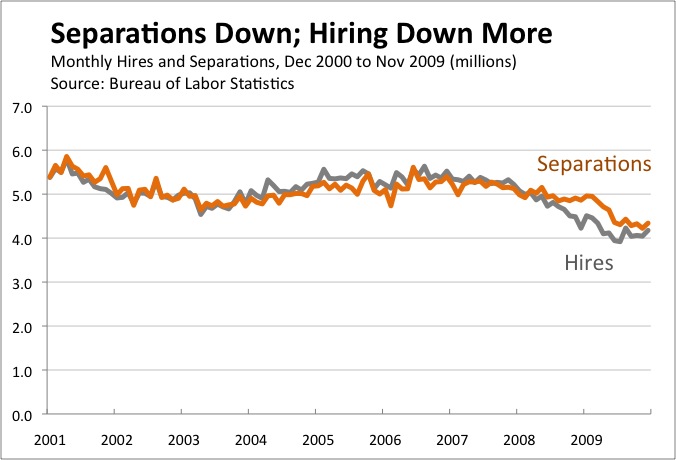
As shown in the following chart, the total number of new hires each month tracks fairly closely over time with the number of people who separate (either voluntarily or involuntarily) from their jobs:

As you would expect, new hires were higher than separations in the middle of the decade when employment was growing. Since the start of the recession, however, separations have outstripped hires by a wide margin.

As the chart shows, overall labor market activity has plummeted over the past two years. New hiring has fallen by more than 1 million workers per month. Employers hired more than 5 million new workers each month back in 2007, but have recently been hiring only slightly more than 4 million. Separations show a similar pattern, as about 1 million fewer workers are leaving their jobs each month than did before the recession.

The decline in separations may seem surprising at first, but is easily understood when separations are divided into layoffs and discharges (i.e., involuntary separations) and quits (i.e., voluntary separations):

As you would expect, layoffs and discharges increased sharply during the recession. During the depths of the financial crisis in late 2008 and early 2009, an average of more than 2.5 million workers lost their jobs each month. The pace of layoffs has since slowed—about 2.1 million workers lost their jobs in November—but remains above levels consistent with growing employment.

Quits, meanwhile, have fallen off a cliff. An average of 1.8 million workers left their jobs voluntarily each month during 2009, about 40 percent lower than the 3.0 million pace a few years ago. In short, many fewer workers are finding opportunities to move to better jobs.

The JOLTS data suggest that the pace of quits may be one of the best signs of a healthy labor market. The uptick in November—to the highest level in ten months—is thus welcome and something to keep an eye on in coming months.

A Sobering Jobs Report

Today’s jobs report invites both negative and positive interpretations.

The positives are fewer, so let’s start with them:

  • With job losses of 85,000, December was the second-best (or, if you prefer, second-least-bad) month since January 2008.
  • With today’s revisions, November actually showed job gains of 4,000, the first increase since December 2007.
  • Put that all together, and job losses averaged 69,000 per month in the last quarter of 2009. That’s unwelcome, but much better than the average of 691,000 jobs lost in each of the first three months of the year.
  • Employment in temporary help services–often viewed as a leading economic indicator–increased by 46,500 in December.

And here are the negatives:

  • December’s job losses were much larger than most forecasters had predicted.
  • The upward revision to November job growth happened only because October jobs were revised down, making November look better. The actual level of November jobs was also revised down (by 1,000).
  • Although the unemployment rate was steady at 10.0%, the details beneath that figure were horrible. Household-reported employment fell by 589,000; the only reason that the unemployment rate stayed constant is that even more people–661,000–dropped out of the labor force.
  • The labor force participation rate thus fell to 64.6% and the employment-to-population ratio fell to 58.2%, the lowest since 1985 and 1983, respectively.
  • The underemployment rate (U-6) increased to 17.3%.

Bottom line: The economy is growing (as suggested by other data), but that growth is not yet translating into new jobs.

Will Rising Government Debt Hurt Growth?

Every January America’s economists gather for their annual conference. There are far more papers than one could ever read (or want to read), so you need a strategy to choose the most important.

In recent years, your optimal strategy should have included the papers by Carmen Reinhart and Ken Rogoff (see, e.g., this prescient paper from 2008). And so it is again in 2010.

This year’s installment is a paper that examines how government debt levels relate to economic growth and inflation. Their key finding? High levels of government debt have a substantial economic cost. In developed economies, that cost is weak economic growth. In emerging economies, that cost is weak economic growth and high inflation.

The growth findings are nicely illustrated in the following table from their paper:

Developed economies that have high levels of government debt (90% of GDP or more) have much lower rates of economic growth; for example, their median rate of growth has been a mere 1.6%, much less than the 3 to 4% growth of countries with lower debt levels. The same pattern holds for emerging economies, as well. (The third panel shows that high levels of public and private external debt also reduce growth, but the sample there includes only emerging economies.)

As R&R note, these results are particularly important today given the rapid growth in government debts around the world. In the United States, for example, debt will probably end the year around 60% of GDP, with no sign of stopping. The good news is that we are still relatively far from the 90% level that R&R identify as problematic. The bad news is that current policies will get us close to that level in less than a decade. For example, the Peterson-Pew Commission on Budget Reform recently projected that current policies would lift the debt-to-GDP ratio to 85% by 2018.

That’s too close for comfort.